You've spent three days backpacking in the Cascades, and somewhere around midnight, you wake up to a cold trickle running down your sleeping bag. Your tent — the one you spent a small fortune on — is leaking. Not because it was cheap. Not because you bought the wrong brand. But because you never understood what was keeping the rain out in the first place.
The fabric of your tent is almost irrelevant without its coating. Nylon and polyester, the two most common tent fabrics on the market, are not naturally waterproof. They're water-resistant at best, and in a sustained downpour, they'll soak through entirely without a chemical treatment applied to their surface or woven structure. That treatment — the waterproof coating — is the real hero of any tent's performance story.
There are two primary coating chemistries used in modern tents: polyurethane (PU) and silicone. They behave differently, age differently, feel different in your hands, and suit different use cases. Getting the right one for your needs isn't a minor detail — it's the difference between a comfortable, dry night and a miserable, wet one.
What Is PU Coating and How Does It Work?
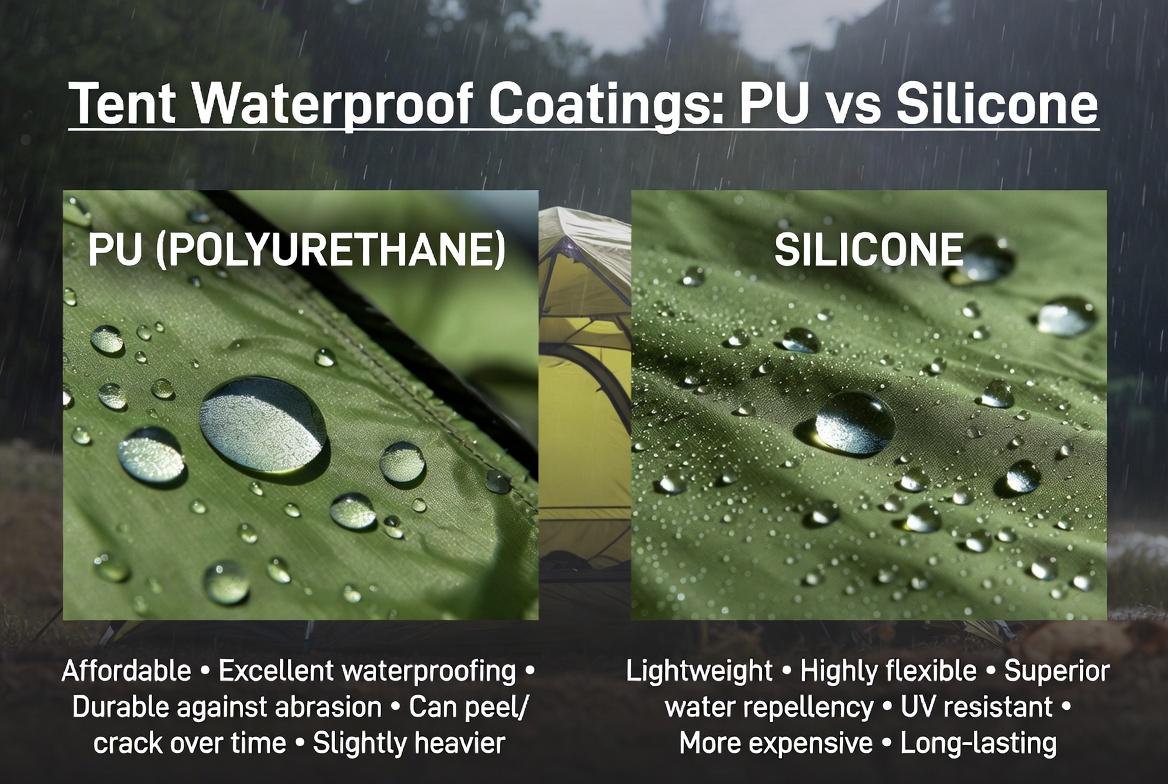
Polyurethane coating is the most widely used waterproofing treatment in the outdoor industry. If you've bought a tent from any mainstream retailer in the past thirty years, chances are high that its flysheet or floor is coated with PU.
The application process involves brushing or rolling a liquid polyurethane compound onto one side of the fabric — almost always the interior face — which then cures into a flexible film. This film creates a watertight barrier that blocks liquid water while remaining somewhat flexible to accommodate the tent's movement in wind and handling.
The performance of a PU coating is measured in millimetres (mm), a figure that refers to the hydrostatic head test. In this test, a column of water is placed above the fabric, and the measurement indicates how tall that column can be before water begins to penetrate. Most quality three-season tents start at around 1,500mm for the flysheet and 3,000mm for the floor. High-end mountaineering tents may reach 10,000mm or beyond.
PU coatings bond well to both nylon and polyester, which is a significant practical advantage. They're relatively easy to manufacture at scale, which keeps costs down. And crucially, PU coatings are repairable — when they begin to peel or crack (and they will, eventually), you can apply aftermarket products like Gear Aid's Seam Grip WP or McNett's Tent Sure to restore the waterproof performance.
The major suppliers of PU coating compounds used in outdoor textiles include Momentive Performance Materials (formerly GE Silicones, headquartered at 260 Hudson River Road, Waterford, NY 12188) and Covestro AG (Kaiser-Wilhelm-Allee 60, 51373 Leverkusen, Germany), though the actual coating is applied by fabric mills and tent manufacturers rather than directly by chemical companies.
What Is Silicone Coating and Why Do Ultralight Hikers Love It?
Silicone coating — colloquially abbreviated to "silnylon" when applied to nylon, or "silpoly" on polyester — is the premium choice in high-performance and ultralight tent design. Instead of sitting on the surface of the fabric, silicone impregnates the weave itself, bonding with individual fibres on both sides of the material.
This dual-sided impregnation is what separates silicone from polyurethane at a fundamental level. The coating doesn't sit on top of the fabric like a paint — it becomes part of the fabric's structure. The result is a material that is lighter, stronger, and dramatically more durable.
Silicone-coated fabrics shed water through a combination of the coating's hydrophobicity and the tightly interlocked structure of the impregnated weave. Water beads and rolls off rather than soaking into the fibres, a property that remains remarkably stable over years of use compared to PU.
The leading fabric manufacturer for silicone-coated outdoor textiles is Dimension-Polyant GmbH (Industriestraße 15, 47906 Kempen, Germany), whose Vectran and DCF (Dyneema Composite Fabric) materials are used by premium tent brands. Shelter Systems in the United States (located at 282 Linden Street, Fort Collins, CO 80524) also works extensively with silicone-treated fabrics for their ultralight shelter line.
Silicone-coated fabrics are also inherently more resistant to UV degradation, which is a significant long-term durability factor for anyone using a shelter frequently. They don't support mould growth as readily as PU coatings, and they maintain their flexibility across a wider temperature range — from desert heat to alpine cold.
The drawback is in the seam sealing. Because silicone repels everything, including adhesives, silicone-treated tents cannot use standard polyurethane seam tape. They must be seam-sealed with silicone-based sealants — typically a silicone-in-solvent solution like McNett's SilNet — which is a more labour-intensive process and often requires re-application every few seasons.
H2: The Degradation Problem — Understanding Hydrolysis
Here's the uncomfortable truth about polyurethane coatings that most tent manufacturers won't tell you on the product page: PU coatings are vulnerable to hydrolysis.
Hydrolysis is a chemical process in which water molecules break apart the polymer chains in the polyurethane. It happens slowly — over years, not days — but it's relentless, and it's accelerated by heat, humidity, and compression (which is why storing a wet tent in a stuff sack is one of the fastest ways to destroy its coating).
When PU coating begins to hydrolyze, the signs are unmistakable. The inner surface of your flysheet starts to feel sticky or tacky to the touch. Then it begins to flake, sometimes in sheets. The tent may start to smell — a faint chemical or "off" odour that is the signature of hydrolytic degradation. Eventually, the coating delaminates entirely.
This is not a failure of craftsmanship. It is a fundamental limitation of polyurethane chemistry. Even tents from premium brands stored under ideal conditions will typically show PU degradation within eight to fifteen years. Tents stored poorly — especially in hot, humid conditions or left wet before storage — can begin showing symptoms within three to five years.
The Outdoor Industry Association (4909 Pearl East Circle, Suite 300, Boulder, CO 80301) has published guidelines recommending that tent owners rinse gear before storage, allow fabrics to dry completely, and store in a cool, dry environment — all of which slow but cannot stop hydrolytic breakdown.
Silicone coatings do not hydrolyze. This is one of the most compelling arguments for silicone-treated shelters among long-term users. A silnylon tarp stored correctly should retain its waterproof performance for decades.
How Manufacturers Apply These Coatings
Understanding the application process explains a great deal about why these two coatings behave the way they do.
PU coating application is a roll-to-roll industrial process. Fabric is fed through a machine that applies liquid polyurethane to one face using a knife-over-roll or comma bar system — essentially a controlled squeegee that deposits a precise thickness of compound. The fabric then passes through a curing oven, where heat causes the polyurethane to cross-link and harden into a flexible film. Quality is determined by coating thickness (measured in grams per square metre of dry coating), the evenness of application, and the specific polyurethane chemistry used.
Some manufacturers apply multiple thin layers rather than a single thick one, which produces a more durable and flexible result. High-end tent brands will specify their coating weight, though this information rarely appears in consumer marketing materials.
Silicone impregnation works differently. Fabric is typically passed through a bath of silicone diluted in a volatile solvent, or the silicone compound is applied under pressure to force it into the fabric weave. The solvent then evaporates (or is recovered and recycled in more environmentally responsible facilities), leaving the silicone behind bonded to the individual fibres. Because both faces of the fabric are treated, the weave itself becomes the waterproof element rather than a surface film.
One complication worth noting: many tents on the market use a hybrid approach. A common configuration is silicone on the outer face (for water beading and UV resistance) with a thin PU layer on the inner face (to enable standard seam tape application). This gives you better bead-off performance than pure PU without the seam-sealing headaches of pure silicone. MSR's Hubba Hubba series, built around fabrics processed at their supply chain partner mills in Southeast Asia, uses this approach for their flysheet construction.
The Role of DWR: A Third Layer in the System
Neither PU nor silicone operates entirely alone in a modern tent system. Most tent fabrics also carry a Durable Water Repellent (DWR) finish — a topical treatment applied to the outer surface of the fabric that causes water to bead and roll off rather than wet out the fibres.
DWR is not the primary waterproof barrier; that role belongs to the coating or laminate. What DWR does is prevent the outer fabric face from becoming saturated, which would add weight and, in PU-coated tents, put more direct hydraulic pressure on the coating itself.
DWR is also the element most likely to wear out first. Repeated washing, abrasion against gear and vegetation, and UV exposure all degrade DWR performance. A tent that appears to be "leaking" is often actually experiencing DWR failure — the outer fabric wets out, and while the coating below is still performing correctly, water vapour inside the tent may condense on the chilled inner fabric surface, creating the impression of a leak.
Restoring DWR is straightforward. Products like Nikwax Tent & Gear SolarWash (available through Nikwax's main distribution hub at Durgates Industrial Estate, Wadhurst, East Sussex TN5 6DF, United Kingdom) or Grangers Performance Repel Plus can be applied at home by either washing the tent with the product in a front-loading machine or spraying it on and heating with a tumble dryer or sun exposure.
Silnylon vs. Silpoly: A Distinction Within Silicone Coatings
The world of silicone-coated fabrics contains its own important subdivision: silnylon (silicone-coated nylon) and silpoly (silicone-coated polyester). This is not a minor technical distinction.
Silnylon — the original and most widespread ultralight fabric — is lighter for a given denier but has one significant drawback: it stretches under load, particularly when wet. This isn't catastrophic, but it means silnylon tarps and tent flies can sag and require re-tensioning during rain. In very high winds, a silnylon shelter can feel like it's breathing.
Silpoly solved this problem. Polyester has significantly lower stretch than nylon, so silpoly fabrics maintain their shape under load and in wet conditions. The tradeoff is a slight weight penalty — polyester fibres are denser than nylon — but most users find the dimensional stability worth it.
Companies like Zpacks (zpacks.com, based in Gainesville, Florida) and Gossamer Gear (909 West Anderson Lane, Austin, TX 78757) have built their entire product philosophies around silicone-coated fabrics, pushing the limits of what's achievable in terms of shelter weight without sacrificing weather performance.
Choosing the Right Coating for Your Use Case
The choice between PU and silicone ultimately comes down to three factors: how you camp, how often you camp, and how much you care about long-term ownership.
Choose PU if: You camp a few times a year, primarily in front-country or car camping situations, and want an affordable, easy-to-maintain shelter. PU-coated tents from brands like REI Co-op (Summit Drive, Kent, WA 98032), Kelty (5765 Arapahoe Avenue, Boulder, CO 80303), and Coleman (3600 N Hydraulic St, Wichita, KS 67219) offer excellent value. When the coating eventually fails, a fresh PU treatment or targeted repairs can extend the life of the tent significantly.
Choose silicone if: You hike frequently, carry your shelter long distances, camp in demanding weather, or expect to use the same tent for a decade or more. Silicone-based shelters represent a higher upfront investment but a lower cost over a long ownership horizon. Brands like Big Agnes (835 Laramie Street, Steamboat Springs, CO 80487), Sea to Summit (Australian-founded, North American distribution through Denver, CO), and Hilleberg the Tentmaker (Ursviken, SE-932 61, Skellefteå, Sweden) all offer models leveraging high-quality silicone-treated fabrics.
Consider hybrid silicone/PU if: You want improved performance over standard PU without the seam-sealing complexity of pure silicone. Most mid-range to premium backpacking tents in the $300–600 range fall into this category and represent the best balance for most three-season backpackers.
Caring for Coated Tent Fabrics
Regardless of which coating your tent uses, a few maintenance practices significantly extend its life.
Never store a tent wet or even damp. Moisture trapped against PU coating accelerates hydrolysis; moisture against any coated fabric promotes mould and mildew. After every trip, set the tent up or hang it in a well-ventilated space until fully dry before packing.
Store loosely rather than tightly compressed. The continuous pressure of a stuff sack against PU coating stresses the polymer film. Many manufacturers now sell or recommend storage bags in a larger size specifically for this reason — MSR (4000 1st Avenue South, Seattle, WA 98134) ships some of their tents with a mesh storage bag separate from the compression stuff sack for exactly this purpose.
Clean with mild soap and cool water only. Detergents, especially those containing surfactants or solvents, can degrade both PU and DWR treatments. Never machine wash on hot, never tumble dry.
Keep the tent out of direct sun when not in use. UV is the enemy of almost every outdoor fabric chemistry, but particularly of PU coatings and nylon fibres. Even a few days of unnecessary sun exposure over the course of a tent's life adds up to measurable degradation.
The Future of Tent Waterproofing
The chemistry of tent coatings isn't standing still. Environmental pressure to eliminate fluorinated compounds from DWR treatments has driven significant investment in new chemistries — silicone-based DWR is now commercially viable and increasingly common, blurring the line between the coating and the DWR layer.
There's also growing interest in thermoplastic polyurethane (TPU) as a more hydrolysis-resistant alternative to conventional PU coatings. TPU films, already common in waterproof-breathable laminates like Gore-Tex, can be engineered to resist hydrolysis far better than traditional PU, though cost remains a barrier at scale.
Meanwhile, Dyneema Composite Fabric (DCF) — formerly marketed as Cuben Fiber — sidesteps the coating question entirely by using a laminated polyethylene matrix that is inherently waterproof. Not strictly a coating at all, DCF represents a different paradigm: the waterproofing is structural, not applied. It's extraordinarily light and completely impervious to hydrolysis, but expensive, prone to tearing along creases, and acoustically noisy. For now, it remains a specialist material for weight-obsessed ultralight users.
The mainstream will remain PU and silicone for the foreseeable future. Understanding both puts you in a far better position to make a purchase decision that holds up — not just in the first rainstorm, but in the tenth, the fiftieth, and the hundredth.
Conclusion: Know What's Between You and the Rain
A tent's waterproof coating is invisible in normal use. You don't see it, you can't feel it, and most manufacturers would rather talk about their pole architecture or their vestibule volume than the chemistry of their flysheet. But it's doing the most important work every time the sky opens up.
PU coatings are the practical, approachable choice — affordable, repairable, widely available, and perfectly adequate for most camping scenarios. Silicone coatings are the performance choice — lighter, more durable, UV-resistant, and immune to hydrolysis. Knowing the difference doesn't just help you buy the right tent. It helps you care for the one you already own, understand its limitations before they catch you out at 2am in a downpour, and extend its useful life by years.
The best shelter isn't necessarily the most expensive one. It's the one you understand.
Information on coating chemistries and manufacturer addresses was current as of publication. Always verify product specifications directly with manufacturers, as formulations and product lines change regularly.