Most people choose a tent by looking at the picture on the box. Two doors, a vestibule, maybe a mesh pocket for a headlamp. What they don't check — until it's 2 a.m. and rain is hammering the fly — is what the fabric is made of.
That single decision, the choice of material, determines how your tent breathes, how long it lasts, how much it weighs on your back, and whether you wake up dry or soaked in condensation. Tent fabric is the difference between a shelter you trust and one you merely hope works. And yet most buyers treat it as an afterthought.
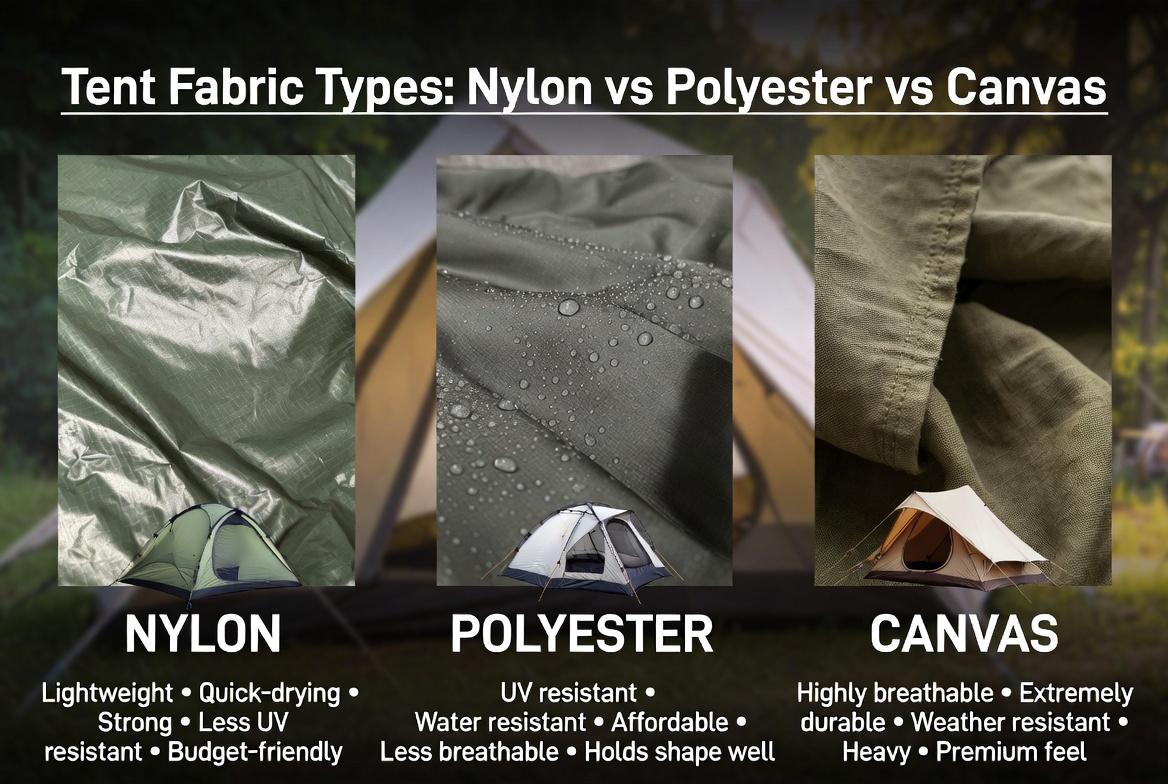
This is a guide to the three main fabric families used in tents today: nylon, polyester, and canvas. Each one has a genuinely different character — different physics, different trade-offs, different loyalists who'll argue for it at a trailhead with surprising conviction. Understanding all three doesn't mean you'll carry a lighter pack. But it means every shelter decision you make from here on will be a deliberate one.
Nylon: The Ultralight Overachiever
Nylon came into the world as a miracle fiber. Developed by DuPont in the 1930s and commercially released in 1939, it was synthetic silk — stronger than silk, cheaper than silk, and capable of being woven into everything from stockings to parachutes. The outdoor industry discovered it and never really let go.
The reason is straightforward: nylon offers the highest tensile strength of any common tent fabric, gram for gram. A 20-denier nylon fabric — paper-thin by any standard — can take considerable punishment before tearing. That strength-to-weight ratio is essentially unmatched. For anyone who has carried a house on their back for 20 miles, this is not an abstract virtue.
How Nylon Performs in the Field
A modern backpacking tent made from 20D or 30D ripstop nylon will stuff down to roughly the size of a Nalgene bottle. You can pack it into a chest pocket if you're creative about it. When manufacturers like Big Agnes, MSR, or Zpacks design their flagship ultralight shelters, they're almost always working with nylon as the base cloth.
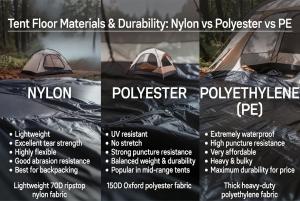
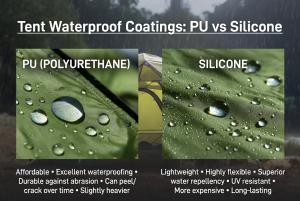
Nylon's waterproofing requires a helping hand. On its own, the fiber is not especially water-resistant. Tent manufacturers solve this with coatings — silicone (sil-nylon), polyurethane (PU), or a combination of both — applied to the fly or both layers. DWR (durable water repellent) treatments are added on top to encourage water to bead off rather than soak in.
The results, when done well, are genuinely impressive. A properly treated nylon fly will handle sustained downpours, sleet, and condensation without issue. The MSR Hubba Hubba NX, one of the most popular backpacking tents in the world, uses ripstop nylon with a 1,500mm hydrostatic head rating — more than enough for serious mountain weather.
The catch, and there is always one, is UV degradation. Nylon is notoriously sensitive to prolonged sun exposure. Leave a nylon tent pitched in direct sunlight for a full summer season and the fabric's polymer chains begin to break down at the molecular level. The coating flakes, the fabric weakens, and the seams start to fail. This isn't a minor inconvenience — it's a tent lifespan cut dramatically short. For three-season backpackers who strike camp by morning, this is rarely an issue. For anyone leaving a tent up for extended periods under open skies, it's a serious concern.
One more quirk: nylon absorbs water into its fibers and then stretches. In heavy rain, a tightly pitched nylon fly can sag enough to touch the inner body, wicking water inside. Experienced nylon tent users know to re-stake and tension the fly during prolonged wet weather. It's a minor ritual, but it matters.
Polyester: The Sensible Middle Ground
Polyester does not have nylon's prestige. It doesn't have the romance of canvas either. What it has is consistency — a fabric that performs predictably across a wide range of conditions, resists UV light with unusual stubbornness, and does all of this without demanding much from its owner.
The outdoor industry took longer to embrace polyester than nylon, in part because early polyester fabrics were heavier and less packable. That changed as weaving and coating technologies improved. Today's 40D, 68D, or 150D polyester tent fabrics are solid performers that have quietly become the standard for family camping tents, festival shelters, and car-camping setups worldwide.
Why Polyester Wins on UV Resistance
Polyester's polymer structure is inherently more stable under ultraviolet radiation than nylon's. A polyester fly pitched in the Arizona desert all summer will outlast a nylon equivalent by years, without any special treatment. Brands like Coleman, Kelty, and REI rely heavily on polyester for their base-camp and car-camping lines precisely because those tents often sit in parks and campgrounds for weeks at a time.
This stability also translates to a longer useful lifespan overall. Where nylon's coatings begin to delaminate within a decade if the tent sees significant sun exposure, a well-stored polyester tent can remain structurally sound for twelve years or more.
Polyester also doesn't absorb water into its fibers the way nylon does, which means it doesn't stretch and sag during rain. The fabric stays dimensionally stable when wet, which simplifies setup and reduces the mid-storm re-tensioning that nylon tents sometimes require. For beginners or casual campers who don't want to think about this — polyester quietly handles it for them.
Where Polyester Falls Short
Weight is the honest answer. A polyester tent offering the same protection as an equivalent nylon design will typically be heavier. Not wildly heavier — we're often talking a few hundred grams — but for ultralight backpackers counting every ounce, those grams matter. You won't find many sub-1kg backpacking tents built from polyester.
Breathability is also not polyester's strength. Like nylon, it's a synthetic with low air permeability, which means condensation management depends entirely on good ventilation design — well-placed vents, mesh inner bodies, and responsible camping habits like leaving the door cracked when conditions allow. Neither nylon nor polyester will save a poorly designed tent from sweating its occupants.
Canvas: The Original, and Still Occasionally the Best
Canvas is what tents were made from before petrochemical synthetics existed. It's woven from natural cotton (or, in some modern versions, a cotton-poly blend) and it has been sheltering humans in hostile weather since long before DuPont or Dow Chemical existed. The bell tent at a British harvest festival, the safari camp in Botswana, the wall tent at a Wyoming elk hunting camp — these are canvas worlds.
The case for canvas is not really a case about weight or packability. On those measures, canvas loses comprehensively. A quality 12-oz canvas bell tent weighs anywhere from 10 to 20 kilograms. You are not carrying this on your back for 15 miles. You are arriving by vehicle, probably with help, and you are setting it up in a place you intend to stay for more than a night.
What canvas offers instead is a different category of shelter experience entirely.
The Breathability Difference
Canvas breathes. Not in the marketing sense of "moisture-wicking technology" — it physically allows air to move through the weave in a way that synthetic fabrics simply cannot replicate. The result is a dramatically different internal climate. In summer heat, a properly ventilated canvas tent is noticeably cooler than a nylon or polyester equivalent pitched in the same sun. In cool, wet weather, condensation — the bane of synthetic tent users — largely disappears. The moisture that would cling to a nylon ceiling and drip onto sleeping bags instead migrates through the canvas weave and evaporates outside.
For anyone who has spent a night in a high-quality canvas bell tent and then returned to a synthetic backpacking tent, the difference is immediately apparent. It feels like sleeping in a real room rather than a plastic bag.
Waterproofing: The Counter-Intuitive Truth
Canvas is not inherently waterproof, and yet it can be extremely effective at keeping water out. The mechanism is different from synthetics. Cotton fibers swell when wet, tightening the weave and closing the gaps water would seep through. New canvas tents need to be "seasoned" before first real use — this involves wetting the canvas thoroughly, allowing it to dry, and repeating the process two or three times so the weave tightens uniformly.
Manufacturers like Sibley, Bell Tent UK (headquartered in Stroud, Gloucestershire, GL5 2BY, United Kingdom), and Elk Mountain Tents (based in Logan, Utah, 84321) apply paraffin wax or silicone-based treatments to speed this process and maintain water repellency over time. With annual re-treatment and proper drying before storage, a quality canvas tent will repel water reliably for decades.
That "decades" is worth pausing on. A well-maintained canvas bell tent or wall tent genuinely can outlast two or three generations of synthetic camping gear. There are working canvas wall tents in Wyoming and Montana that are 40 years old and still serviceable. The Springbar brand, manufactured in Salt Lake City, Utah 84116 since 1961, has built its entire reputation on this longevity. Their canvas cabin tents routinely appear in second-hand markets not because they've failed, but because their original owners simply stopped needing them.
The Canvas Caveats
The weight and bulk are non-starters for trail use, as already acknowledged. But canvas has two additional vulnerabilities worth naming plainly.
Mold. If canvas is stored damp — even slightly damp — it will mold. This is not a minor aesthetic issue. Mold attacks the cotton fibers and permanently weakens them. Preventing it requires a discipline around drying and storage that synthetics simply don't demand. A polyester tent can be stuffed into a bag still damp and pulled out a month later with nothing worse than a slightly musty smell. Canvas does not offer that forgiveness.
Cost. Quality canvas tents are expensive. A Sibley 500 Ultimate Tipi retails for over £600. A Springbar Traveler 4 sells for upwards of $700 USD. The premium reflects the weight of the material, the cost of construction, and frankly the longevity you're purchasing. But it's a real barrier to entry that synthetics don't present.
The Denier Question: How to Read the Numbers
Whatever fabric you're shopping in, you'll encounter denier ratings — 20D, 40D, 68D, 150D. Denier is a unit of fiber thickness: specifically, the mass in grams of 9,000 meters of a single fiber. Higher denier means thicker, heavier, more abrasion-resistant fabric. Lower denier means lighter, more packable, but potentially more vulnerable to sharp objects.
For backpacking tents, 20D to 30D nylon strikes the balance most designers prefer. For car-camping and family tents, 40D to 150D polyester gives the durability that families dragging gear across gravel car parks need. Canvas ratings work differently — ounces per square yard — and 10–12 oz/yd² suits most three-season use, while 16–24 oz/yd² is reserved for serious winter or extended expedition use.
Silnylon vs. Silpoly: The Coated Fabric Debate
Within synthetic tent fabrics, a sub-debate has been simmering for years between silicone-coated nylon (silnylon) and silicone-coated polyester (silpoly). Both are popular in the ultralight and cottage-industry tent world.
Silnylon is lighter. At the same denier, a silnylon fabric will typically weigh less than its silpoly counterpart — valuable when every gram is contested. But it has the wet-stretch issue and the UV vulnerability of base nylon.
Silpoly offers the dimensional stability and UV resistance of polyester with the improved performance of a silicone coating. Manufacturers like Zpacks, Tarptent, and Gossamer Gear have increasingly moved toward silpoly for flys and tarps. Tarptent, based in Tucson, Arizona 85705, offers several models with silpoly flys specifically because long-distance hikers on routes like the PCT spend weeks in sustained sun exposure where nylon would gradually break down.
Neither is universally superior. The right choice depends on how you weight the trade-offs of your specific use case.
How to Match Fabric to Your Camping Style
The comparison table at the top of this piece lays out the numbers. Here is the translation into plain decisions.
If you are a backpacker — someone who carries everything they own for multiple days — nylon is almost certainly your material. The weight savings are real, the strength is real, and with proper care and storage, the limitations are manageable. Keep it out of extended direct sun, re-apply DWR when water stops beading, store it dry, and a quality nylon tent will serve you faithfully for many seasons.
If you are a car camper, a family camper, or someone whose tent sees the inside of a roof rack more than a trail — polyester is the sensible choice. It's dimensionally stable, UV resistant, low maintenance, and available at every price point from budget to premium. The extra weight doesn't matter when you're driving to the campsite.
If you are someone who camps in one place for extended periods — at a festival, on a base camp, in a large group, at a hunting or fishing camp, or simply with an enthusiasm for the craft of outdoor living — canvas rewards serious attention. The investment is higher, the maintenance more demanding, but the shelter it provides is in a genuinely different category. And it will likely outlast you.
A Note on Blended and Technical Fabrics
The three families above are not exhaustive of the full market. Dyneema Composite Fabric (formerly Cuben Fiber), made by Cubic Tech in Casa Grande, Arizona 85122, represents the extreme end of the performance spectrum — incredibly light, completely waterproof, and priced accordingly. A Dyneema tent fly can weigh under 200 grams for a two-person shelter. It is a niche product for committed minimalists, but it points toward where high-performance tent fabrics are heading.
Cotton-poly blends occupy the space between canvas and synthetics — lighter than pure cotton, more breathable than pure polyester, marketed heavily by brands like Outwell and Nordisk to European family campers who want the feel of canvas without the full weight penalty.
Closing Thoughts: The Fabric Is the Tent
The poles give a tent its shape. The design determines its livability. But the fabric is the tent — it is the actual boundary between you and weather, between comfort and disorientation at 3 a.m. when a storm comes through faster than the forecast promised.
Nylon is fast, light, and technically brilliant. Polyester is patient, stable, and underrated. Canvas is slow, heavy, and magnificent.
Each one is the right answer for somebody. The question is whether you know which somebody that is before you hand over the money.